
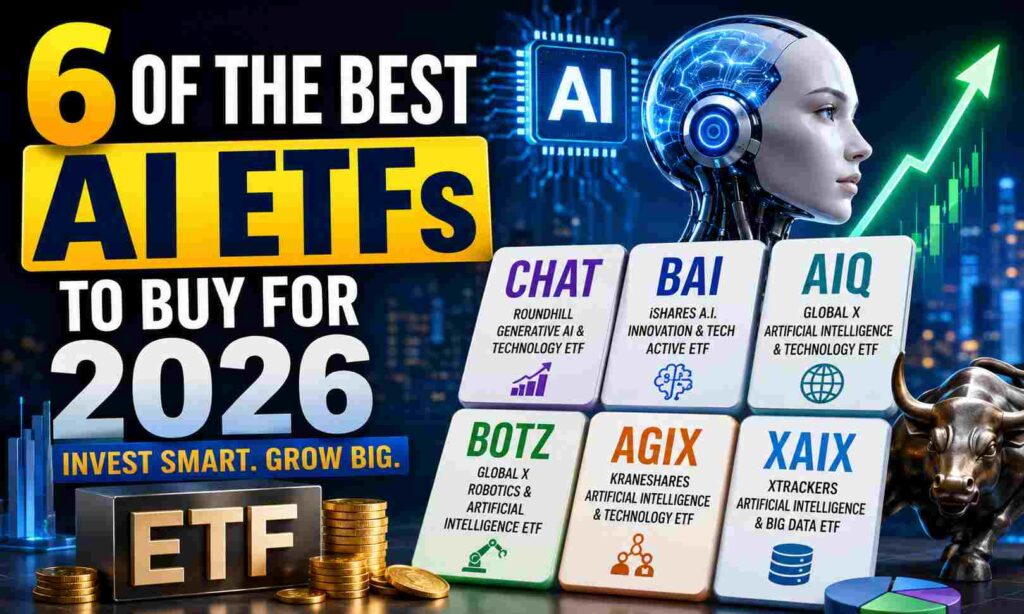
Best AI ETFs to Buy in 2026: Where Smart Money Is Heading Next
Artificial intelligence isn’t just powering the next generation of technology—it’s becoming one of Wall Street’s biggest investment themes. After another blockbuster year for AI stocks, investors are increasingly turning to ETFs to gain diversified exposure without betting everything on a single company like Nvidia or Microsoft.
If you’re searching for the Best AI ETFs to Buy in 2026, you’re entering one of the fastest-growing corners of the ETF market. According to ETF industry data, AI-focused exchange-traded funds generated impressive average one-year returns while attracting billions of dollars in new investments. That combination of strong performance and continued capital inflows suggests investors still see significant long-term growth despite concerns about lofty valuations.
But here’s the catch: not every AI ETF follows the same strategy.
Some focus on generative AI software. Others invest in robotics, semiconductor manufacturers, cloud infrastructure, or even private AI companies unavailable to ordinary investors. Choosing the right ETF depends on your risk tolerance, investment horizon, and belief in where artificial intelligence is heading next.
Table of Contents
Why AI ETFs Are Becoming One of the Hottest Investment Themes
The AI boom has expanded well beyond chatbots and virtual assistants.
Today, artificial intelligence is reshaping industries including healthcare, finance, cybersecurity, manufacturing, cloud computing, autonomous vehicles, and enterprise software. Rather than trying to predict which individual company will dominate over the next decade, many investors prefer AI ETFs because they spread risk across dozens—or even hundreds—of companies driving the AI revolution.
Some of the biggest trends fueling AI ETF growth include:
- Explosive demand for AI chips and data centers.
- Massive enterprise spending on generative AI software.
- Growing investment in robotics and automation.
- Rapid cloud infrastructure expansion.
- Increasing government and private-sector AI funding.
The result? AI ETFs have become one of the fastest-growing categories in thematic investing.
Quick Comparison: Best AI ETFs to Buy in 2026
| ETF | Ticker | Expense Ratio | Investment Focus |
|---|---|---|---|
| Roundhill Generative AI & Technology ETF | CHAT | 0.75% | Generative AI Leaders |
| iShares A.I. Innovation & Tech Active ETF | BAI | 0.55% | Actively Managed AI Stocks |
| Global X Artificial Intelligence & Technology ETF | AIQ | 0.68% | Global AI & Big Data Companies |
| Global X Robotics & Artificial Intelligence ETF | BOTZ | 0.68% | Robotics & Industrial Automation |
| KraneShares Artificial Intelligence & Technology ETF | AGIX | 0.99% | Public + Private AI Companies |
| Xtrackers Artificial Intelligence & Big Data ETF | XAIX | 0.35% | Patent-Driven AI Innovation |
1. Roundhill Generative AI & Technology ETF (NYSEARCA: CHAT)
If you’re looking for an ETF designed specifically around generative AI, CHAT deserves serious attention.
Unlike passive funds that simply track an index, Roundhill actively manages this portfolio. The investment team evaluates earnings calls, AI-related research spending, company disclosures, and overall exposure to generative AI before selecting holdings.
That flexibility has helped CHAT outperform both the S&P 500 and the Nasdaq-100 since its launch.
Why Investors Like CHAT
- Focused entirely on the generative AI revolution.
- Actively managed portfolio adapts to market changes.
- Can quickly add emerging AI leaders.
- Strong historical performance versus broader indexes.
Potential Drawbacks
- Higher 0.75% expense ratio.
- Performance depends heavily on portfolio managers.
- More concentrated than diversified index ETFs.
Who Should Buy CHAT?
Investors who believe generative AI will remain the biggest technology trend of the decade—and are comfortable paying slightly higher management fees for active stock selection.
2. iShares A.I. Innovation and Tech Active ETF (NYSEARCA: BAI)
For investors seeking active management backed by one of the world’s largest asset managers, BAI stands out.
Managed by BlackRock’s technology investment team, this ETF blends fundamental company research with AI-focused investment opportunities. Its relatively low expense ratio of 0.55% also makes it cheaper than many competing actively managed AI funds.
One of its biggest selling points has been exceptional recent performance, with returns significantly outperforming many broader technology funds.
Key Strengths
- Managed by BlackRock’s experienced technology team.
- Competitive management fee.
- Broad exposure to AI software and hardware companies.
- Strong recent returns.
Possible Risks
- Active management introduces manager risk.
- Portfolio composition may change rapidly.
- Technology sector volatility remains high.
Best For
Long-term investors looking for professional stock selection without paying extremely high management costs.
3. Global X Artificial Intelligence & Technology ETF (NASDAQ: AIQ)
Among the largest AI-focused ETFs on the market, AIQ offers one of the most diversified approaches to artificial intelligence investing.
The fund tracks the Indxx Artificial Intelligence & Big Data Index and currently holds more than 80 companies spanning semiconductors, enterprise software, cloud computing, memory chips, and AI infrastructure.
Recent gains in memory-chip manufacturers like Micron, Samsung Electronics, and SK hynix have helped fuel AIQ’s strong performance.
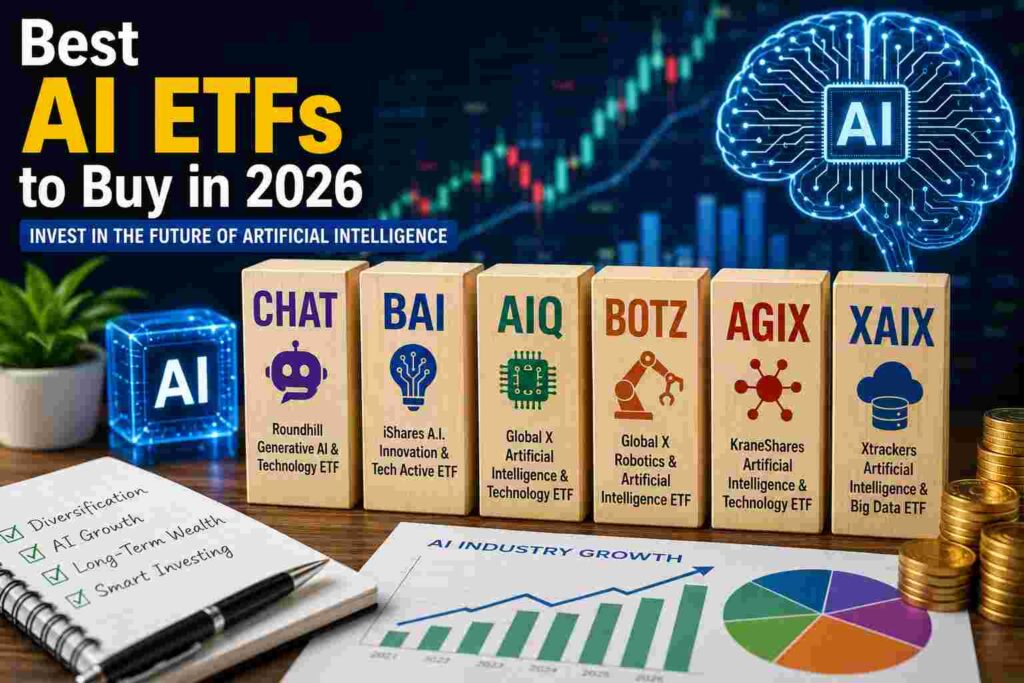
Why AIQ Is Popular
- Broad diversification across the AI ecosystem.
- Global exposure beyond U.S. technology stocks.
- Large asset base exceeding billions of dollars.
- Ideal for investors seeking balanced AI exposure.
Things to Consider
- More volatile than the overall stock market.
- Technology valuations remain relatively expensive.
- AI enthusiasm could lead to short-term price swings.
Why Diversification Still Matters in AI Investing
One mistake many new investors make is assuming today’s AI leaders will dominate forever.
History tells a different story. During previous technology booms, market leadership shifted multiple times as innovation accelerated. AI is likely to follow a similar path.
That’s why diversified ETFs can reduce company-specific risk while still allowing investors to participate in the long-term growth of artificial intelligence.
For example, while hardware companies currently dominate AI headlines, software developers, cybersecurity firms, cloud providers, healthcare innovators, and enterprise AI companies could become tomorrow’s biggest winners.
Related AI & Tech Stories
- Powerful Google Search Agent Monitors the Web 24/7
- Eight Sleep Pod AI Mattress Review: The AI Mattress Changing Sleep
- Shocking Apple India Antitrust Case Takes a Dramatic Turn
Now We’ll explore BOTZ, AGIX, and XAIX, compare their investment strategies, examine portfolio risks, and reveal which AI ETF may be the best fit for growth, income, and long-term investors.
4. Global X Robotics & Artificial Intelligence ETF (NASDAQ: BOTZ)
If you believe the next phase of artificial intelligence extends beyond software and into factories, hospitals, warehouses, and autonomous machines, BOTZ deserves a place on your watchlist.
Unlike many AI ETFs that concentrate heavily on software developers and cloud providers, BOTZ leans toward industrial automation and robotics companies. That makes it a unique way to invest in AI’s physical-world applications.
The fund has significant exposure to Japanese robotics manufacturers, industrial automation leaders, and healthcare technology companies. As labor shortages continue worldwide, demand for intelligent robots is expected to grow rapidly across manufacturing, logistics, and healthcare.
Why Investors Like BOTZ
- Strong exposure to industrial robotics.
- Benefits from factory automation trends.
- Diversified internationally, especially in Japan.
- Includes healthcare robotics leaders like Intuitive Surgical.
Potential Risks
- Industrial stocks can be cyclical.
- Less exposure to generative AI software.
- Global manufacturing slowdowns could impact returns.
Best For
Long-term investors who believe robotics, automation, and AI-powered manufacturing will become trillion-dollar industries over the next decade.
5. KraneShares Artificial Intelligence & Technology ETF (NYSEARCA: AGIX)
Most AI ETFs only invest in publicly traded companies.
AGIX takes a different approach.
In addition to publicly listed AI companies, the fund also allocates a small portion of its portfolio to private firms, giving investors indirect exposure to businesses that aren’t normally available through traditional stock markets.
One of the fund’s most talked-about holdings has been Anthropic, the company behind Claude AI. It has also held exposure to investment vehicles linked to SpaceX.
This strategy gives AGIX something few competitors can offer: limited access to some of the world’s fastest-growing private AI businesses.
Advantages
- Exposure to private AI companies.
- Diversified public AI holdings.
- Unique investment strategy.
- Potential upside from emerging innovators.
Drawbacks
- Highest expense ratio among this list (0.99%).
- Private investments may be less liquid.
- Higher risk than traditional ETFs.
Best For
Growth investors comfortable with additional risk who want indirect exposure to next-generation AI startups.
6. Xtrackers Artificial Intelligence & Big Data ETF (NASDAQ: XAIX)
If low costs matter to you, XAIX immediately stands out.
With an expense ratio of just 0.35%, it’s one of the most affordable AI ETFs available today.
Instead of relying solely on market capitalization, XAIX uses a patent-based methodology to identify companies actively investing in artificial intelligence research and development.
That’s an interesting twist.
Companies filing meaningful AI patents today could become tomorrow’s industry leaders before Wall Street fully recognizes their potential.
Why XAIX Stands Out
- Lowest expense ratio on this list.
- Patent-driven stock selection.
- Global AI exposure.
- Strong focus on long-term innovation.
Potential Weaknesses
- Patent activity doesn’t always translate into profits.
- Some smaller innovators can be volatile.
- May lag momentum-driven AI rallies.
Best For
Cost-conscious investors building long-term AI portfolios.
How Do These AI ETFs Compare?
| ETF | Best Feature | Risk Level | Ideal Investor |
|---|---|---|---|
| CHAT | Generative AI Focus | High | Aggressive Growth |
| BAI | Active Management | Medium-High | Long-Term Investors |
| AIQ | Broad Diversification | Medium | Most Investors |
| BOTZ | Robotics & Automation | Medium | Industrial AI Investors |
| AGIX | Private AI Exposure | High | Aggressive Growth |
| XAIX | Lowest Fees | Medium | Buy-and-Hold Investors |
What Are the Biggest Risks of Investing in AI ETFs?
Artificial intelligence remains one of the fastest-growing investment themes—but it isn’t risk-free.
Before buying any AI ETF, investors should understand several important risks.
- Technology stocks can experience significant price swings.
- Many AI companies trade at premium valuations.
- Government regulation around AI continues to evolve.
- Rapid innovation means today’s leaders may not dominate tomorrow.
- Some ETFs rely heavily on a handful of mega-cap technology companies.
Diversification helps reduce company-specific risk, but it doesn’t eliminate market risk.
Which AI ETF Is Right for You?
The answer depends on your investment goals.
| If You Want… | Consider… |
|---|---|
| Maximum AI Growth | CHAT |
| Professional Active Management | BAI |
| Broad Diversification | AIQ |
| Robotics Exposure | BOTZ |
| Private AI Companies | AGIX |
| Lowest Costs | XAIX |
How AI ETFs Fit Into a Diversified Portfolio
AI ETFs shouldn’t necessarily replace broad-market investments like S&P 500 index funds.
Instead, many financial professionals view thematic ETFs as satellite positions that complement a diversified portfolio.
For investors with a long time horizon, allocating a portion of their portfolio to AI-focused funds may provide additional growth potential while maintaining diversification through broader equity investments.
As always, your allocation should reflect your financial goals, time horizon, and risk tolerance rather than short-term market excitement.
Related Articles
- Powerful Google Search Agent Monitors the Web 24/7
- Eight Sleep Pod AI Mattress Review: The AI Mattress Changing Sleep
- Shocking Apple India Antitrust Case Takes a Dramatic Turn
- Samsung One UI 9 Testing Just Expanded to the Galaxy A24, A35, and A07
Trusted Sources
Should You Invest in AI ETFs in 2026?
Artificial intelligence has already transformed how businesses operate, but many analysts believe the technology is still in its early innings. Companies are investing billions of dollars in AI infrastructure, cloud computing, semiconductor manufacturing, enterprise software, robotics, and automation.
For individual investors, that creates an opportunity—but also a challenge.
Picking the next Nvidia before it explodes isn’t easy. History shows that many early technology leaders fade while new innovators emerge. That’s one reason AI-focused ETFs continue attracting billions in fresh capital: they provide exposure to an entire ecosystem instead of relying on a single winner.
That said, investors shouldn’t mistake a strong trend for a guaranteed return. Many AI-related companies trade at premium valuations, and technology stocks can experience sharp corrections. Even the strongest long-term themes rarely move in a straight line.
Expert Take: Which AI ETF Stands Out?
Each fund on this list serves a different purpose, so there isn’t a universal “best” choice.
- CHAT is ideal for investors seeking concentrated exposure to generative AI companies.
- BAI appeals to those who prefer active management backed by BlackRock’s technology team.
- AIQ offers one of the most diversified ways to invest across the AI ecosystem.
- BOTZ focuses on robotics, automation, and industrial AI.
- AGIX provides rare exposure to select private AI companies alongside public holdings.
- XAIX combines a low expense ratio with a patent-driven investment methodology.
If you’re new to thematic investing, diversification and cost efficiency generally matter more than chasing the hottest fund from the past year. Investors should also review each ETF’s holdings regularly, since portfolios can change over time.
Key Takeaways
- AI remains one of the fastest-growing investment themes heading into 2026.
- AI ETFs provide diversified exposure across software, semiconductors, cloud computing, robotics, and big data.
- Expense ratios, portfolio concentration, and investment strategy vary significantly between funds.
- No single AI ETF fits every investor; the right choice depends on your objectives and risk tolerance.
- Long-term investors may benefit from combining AI ETFs with broader index funds as part of a diversified portfolio.
Final Verdict
The Best AI ETFs to Buy in 2026 offer investors a practical way to participate in one of the world’s most transformative technologies without relying on a single company.
Whether artificial intelligence reshapes healthcare, cybersecurity, enterprise software, autonomous vehicles, or manufacturing, ETFs allow investors to spread risk while maintaining exposure to the broader trend.
Still, disciplined investing matters. AI is a powerful long-term theme, but successful portfolios are built through diversification, patience, and regular review—not by chasing headlines.
Which AI ETF would you add to your portfolio in 2026—CHAT, AIQ, BOTZ, or another fund? Share your thoughts in the comments below and let us know why.
Frequently Asked Questions
What are the best AI ETFs to buy in 2026?
Some of the leading AI ETFs include Roundhill Generative AI & Technology ETF (CHAT), iShares A.I. Innovation and Tech Active ETF (BAI), Global X Artificial Intelligence & Technology ETF (AIQ), Global X Robotics & Artificial Intelligence ETF (BOTZ), KraneShares Artificial Intelligence & Technology ETF (AGIX), and Xtrackers Artificial Intelligence and Big Data ETF (XAIX).
Are AI ETFs a good long-term investment?
AI ETFs can be attractive long-term investments because they provide diversified exposure to companies developing artificial intelligence technologies. However, returns are never guaranteed, and investors should consider their financial goals and risk tolerance before investing.
Which AI ETF has the lowest expense ratio?
Among the ETFs covered in this article, Xtrackers Artificial Intelligence and Big Data ETF (XAIX) has the lowest expense ratio at 0.35%.
What is the difference between AIQ and BOTZ?
AIQ focuses broadly on artificial intelligence and big data companies across multiple industries, while BOTZ places greater emphasis on robotics, automation, and industrial AI applications.
Does any AI ETF invest in private AI companies?
Yes. KraneShares Artificial Intelligence & Technology ETF (AGIX) includes limited exposure to certain private AI companies alongside publicly traded holdings.
Should beginners invest in AI ETFs?
Beginners often prefer diversified ETFs because they reduce company-specific risk. AI ETFs can complement a broader investment portfolio but generally shouldn’t replace diversified index funds entirely.
Are AI ETFs riskier than S&P 500 ETFs?
Generally, yes. AI ETFs are thematic investments and tend to have higher volatility than broad-market index funds because they concentrate on a specific sector.
How often do AI ETFs change their holdings?
It depends on the fund. Passive ETFs rebalance according to their indexes, while actively managed ETFs may adjust holdings more frequently based on market conditions.
Can AI ETFs outperform the stock market?
Some AI ETFs have outperformed major indexes during periods of strong AI growth. However, past performance does not guarantee future results, and performance can vary significantly over time.
Are AI ETFs suitable for retirement accounts?
Many investors hold AI ETFs within retirement accounts as part of a diversified strategy. The suitability depends on individual investment objectives, time horizon, and overall asset allocation.
What should investors look for before buying an AI ETF?
Review the fund’s investment strategy, holdings, expense ratio, diversification, historical performance, and overall risk profile before making an investment decision.
Will AI continue driving stock market growth in 2026?
Many analysts expect AI to remain a major investment theme in 2026, supported by continued spending on chips, cloud infrastructure, enterprise software, and automation. However, market conditions can change, and future performance cannot be predicted with certainty.
Disclaimer: This article is for educational and informational purposes only and should not be considered financial, investment, tax, or legal advice. Always conduct your own research or consult a qualified financial advisor before making investment decisions. Investments in ETFs and stocks involve risk, including the possible loss of principal.