Microsoft is quietly making one of the biggest AI strategy shifts of 2026. Instead of relying almost entirely on OpenAI and Anthropic, the tech giant has begun deploying its own Microsoft MAI AI models inside popular productivity apps including Excel, Outlook, and GitHub Copilot. While most users won’t notice the transition, the decision could reshape the economics of enterprise AI and redefine Microsoft’s role in the global artificial intelligence race.
For years, Microsoft’s multibillion-dollar partnership with OpenAI gave the company a significant edge in generative AI. Services like Microsoft 365 Copilot, GitHub Copilot, and intelligent productivity tools depended heavily on OpenAI’s large language models. Now, Microsoft appears to be entering a new phase—one where it owns more of the AI stack instead of renting it.
The move isn’t just about technology. It’s about controlling costs, improving margins, reducing long-term dependence on third-party AI providers, and building a sustainable ecosystem that can support billions of AI-powered interactions every day.
If Microsoft’s strategy succeeds, it could become one of the most significant competitive developments in enterprise AI since the launch of ChatGPT.
Table of Contents
Why Microsoft Is Replacing OpenAI and Anthropic in Some Apps
Microsoft’s latest AI strategy isn’t about ending its relationship with OpenAI—it’s about gaining more control over one of the fastest-growing expenses inside the company: AI inference costs.
According to reports, tens of thousands of AI prompts generated every week inside Microsoft Excel and Microsoft Outlook are now being handled by the company’s internally developed Microsoft MAI AI models. Previously, many of these requests relied on AI models from OpenAI and Anthropic.
The change may sound minor today, but it represents a major shift in Microsoft’s long-term AI roadmap. Every AI-generated email draft, spreadsheet formula, document summary, or Copilot suggestion requires computing resources. At Microsoft’s scale, those requests quickly add up to billions of AI tokens every month.
Even with Microsoft’s close partnership with OpenAI, relying on external AI providers indefinitely comes with financial risks. If model pricing changes or enterprise AI demand continues to grow at its current pace, operating costs could increase dramatically.
Building proprietary AI models gives Microsoft greater flexibility over pricing, performance optimization, and future product development.
What Are Microsoft MAI AI Models?
MAI is Microsoft’s family of internally developed large language models designed to power AI experiences across the company’s software ecosystem. Unlike OpenAI’s GPT models or Anthropic’s Claude models, MAI is optimized specifically for Microsoft’s own services and enterprise workloads.
Instead of creating one general-purpose chatbot, Microsoft is developing specialized models that can efficiently perform everyday productivity tasks such as:
- Writing professional emails
- Summarizing meetings and documents
- Generating Excel formulas
- Creating PowerPoint presentations
- Producing software code suggestions
- Transcribing Teams meetings
- Answering enterprise knowledge queries
This targeted approach allows Microsoft to deliver comparable performance for many common workplace tasks while using significantly fewer computing resources than some frontier AI models.
For enterprise customers, that could translate into faster response times, lower operational costs, and more predictable AI performance across Microsoft 365.
Microsoft Wants to Reduce Its Dependence on External AI Providers
Microsoft’s investment in OpenAI remains one of the most influential partnerships in artificial intelligence. However, relying too heavily on any single AI provider creates strategic challenges.
Mustafa Suleyman, Microsoft’s Executive Vice President of AI, has already indicated that the company’s objective is to reduce spending on third-party AI models wherever internally developed alternatives can deliver similar results.
That doesn’t necessarily mean OpenAI or Anthropic will disappear from Microsoft’s products. Instead, Microsoft appears to be adopting a multi-model strategy, selecting the most efficient model for each individual task.
Simple workplace requests may increasingly be processed using MAI models, while highly complex reasoning or advanced coding tasks could still rely on OpenAI’s latest GPT models or Anthropic’s Claude models when necessary.
This approach allows Microsoft to balance quality, speed, and infrastructure costs without sacrificing the overall user experience.
Why AI Costs Have Become Microsoft’s Biggest Challenge
Generative AI has opened enormous business opportunities, but it has also introduced an entirely new category of operating expenses. Every AI interaction consumes processing power inside massive data centers equipped with thousands of high-performance GPUs.
Microsoft serves hundreds of millions of users across Windows, Microsoft 365, GitHub, Azure, Teams, Bing, and Copilot. As AI becomes integrated into nearly every product, infrastructure costs continue climbing.
Developing proprietary models offers several strategic advantages:
- Lower long-term AI operating costs
- Reduced dependence on third-party pricing
- Better optimization for Microsoft software
- Greater control over enterprise security
- Faster deployment of new AI features
- Improved scalability as AI usage grows
From an investor’s perspective, this strategy could significantly improve Microsoft’s AI profit margins over the coming years. Instead of paying external providers for every AI request, Microsoft can increasingly rely on technology it owns and controls.
That’s an important distinction as enterprise AI adoption accelerates across businesses worldwide.
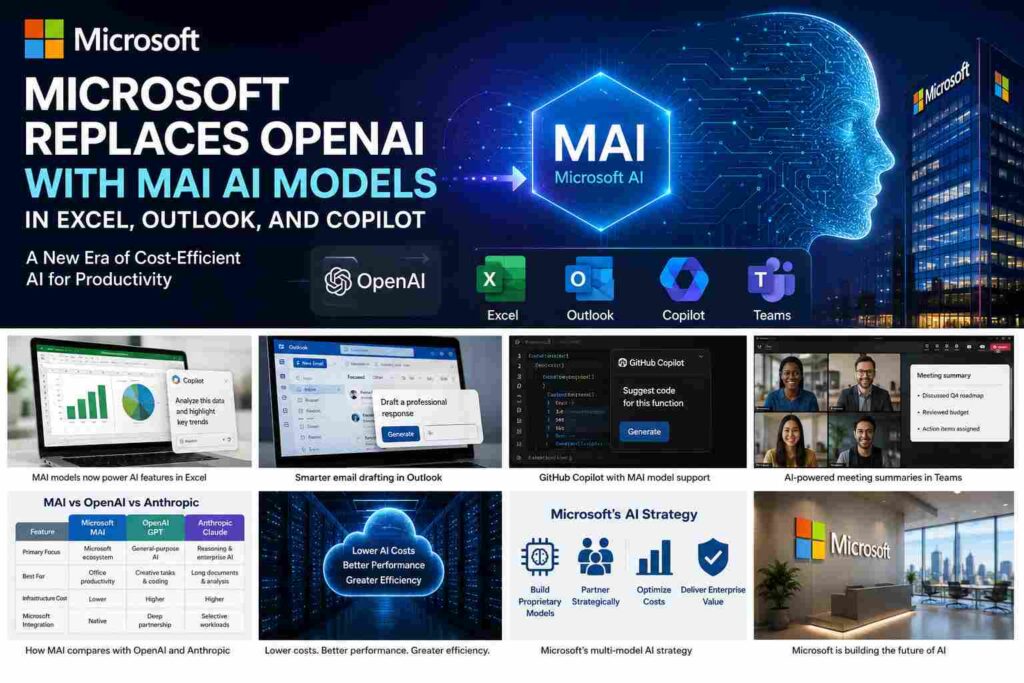
How Microsoft MAI AI Models Are Changing Excel, Outlook, GitHub Copilot, and Teams
Microsoft isn’t replacing OpenAI across its entire ecosystem overnight. Instead, the company is taking a measured approach by introducing Microsoft MAI AI Models into specific workloads where they can deliver similar results at a lower cost.
The first noticeable changes are happening inside productivity applications that millions of professionals use every day. These apps generate an enormous volume of AI requests, making them the perfect environment to test Microsoft’s in-house models at scale.
Excel Gets Smarter—and Potentially Faster
Microsoft Excel has evolved far beyond spreadsheets. Today, Copilot can explain formulas, analyze large datasets, create charts, identify trends, and even generate complete financial reports.
Many of these AI-assisted tasks don’t require the most advanced frontier models available. Microsoft’s MAI models are designed to handle routine productivity requests efficiently while reducing computational costs.
For business users, this could mean:
- Faster spreadsheet analysis
- Quicker formula generation
- Lower latency during AI-assisted workflows
- Improved reliability during peak usage
Outlook AI Becomes More Cost-Efficient
Email remains one of the most common workplace activities, making Outlook one of Microsoft’s busiest AI-powered applications.
Every time Copilot drafts an email, summarizes a conversation, suggests a response, or rewrites a message, AI processing takes place behind the scenes.
By routing many of these everyday requests through MAI models, Microsoft can significantly reduce infrastructure expenses without noticeably changing the experience for end users.
Most professionals will likely never know which AI model generated a particular response—and that’s exactly Microsoft’s goal.
GitHub Copilot Continues Expanding
Developers remain one of Microsoft’s most valuable AI customer groups.
The company has already confirmed that Microsoft MAI AI Models are available inside GitHub Copilot, giving developers additional model choices depending on their coding needs.
Rather than relying on a single AI provider, GitHub Copilot is evolving into a multi-model platform capable of selecting different AI engines for different programming tasks.
This flexibility helps Microsoft improve performance while avoiding excessive dependence on external model providers.
Microsoft Teams Will Soon Benefit Too
Microsoft’s AI ambitions extend beyond Office applications.
According to company executives, MAI-powered transcription technology will soon begin handling meeting transcription inside Microsoft Teams and additional enterprise products.
Meeting summaries, speaker identification, searchable transcripts, and automated action items are expected to become faster and more cost-efficient as Microsoft’s proprietary AI infrastructure continues to mature.
Given the explosive growth of hybrid work, Teams represents one of Microsoft’s largest opportunities to deploy its own AI models at enterprise scale.
Why Microsoft’s AI Strategy Could Change the Enterprise Software Market
This shift isn’t simply about replacing one AI model with another.
Microsoft is attempting to solve one of the biggest challenges facing the entire AI industry: how to make generative AI financially sustainable.
Training advanced language models requires billions of dollars, but serving those models to hundreds of millions of users every day creates an even larger long-term expense.
Owning more of the AI technology stack gives Microsoft several strategic advantages:
- Greater pricing control for Microsoft 365 Copilot
- Lower operating costs across Office applications
- Reduced dependence on external AI vendors
- Improved data governance for enterprise customers
- More flexibility to customize models for specific business workloads
- Higher long-term profit margins from AI subscriptions
For enterprise customers already investing heavily in Microsoft 365, these improvements could eventually translate into better AI performance without significant increases in subscription pricing.
That’s particularly important as businesses evaluate the return on investment of deploying AI assistants across thousands of employees.
Microsoft Is Building an AI Ecosystem—Not Just an AI Assistant
Over the past three years, Microsoft has transformed AI from a standalone feature into the foundation of nearly every major product it offers.
From Windows and Azure to GitHub, Teams, Dynamics 365, and Microsoft 365, artificial intelligence is becoming deeply integrated throughout the company’s ecosystem.
The introduction of MAI models demonstrates that Microsoft no longer wants to be viewed solely as OpenAI’s largest investor. Instead, it is positioning itself as an AI platform company capable of developing, deploying, and optimizing its own foundation models while continuing to work with leading external partners when appropriate.
That strategy could give Microsoft a significant competitive advantage as enterprise demand for AI continues accelerating over the next decade.
Microsoft MAI vs OpenAI vs Anthropic: What’s the Difference?
Microsoft isn’t abandoning OpenAI or Anthropic. Instead, it’s building a flexible AI ecosystem where multiple models work together based on the task at hand. This approach allows Microsoft to optimize performance, cost, and efficiency across its growing portfolio of AI-powered products.
| Feature | Microsoft MAI | OpenAI GPT | Anthropic Claude |
|---|---|---|---|
| Primary Focus | Microsoft ecosystem | General-purpose AI | Reasoning & enterprise AI |
| Best For | Office productivity | Creative tasks & coding | Long documents & analysis |
| Infrastructure Cost | Lower | Higher | Higher |
| Microsoft Integration | Native | Deep partnership | Selective workloads |
| Customization | Highly optimized | Broad capabilities | Enterprise-focused |
Rather than choosing a single AI provider, Microsoft appears to be creating a layered AI architecture where the most suitable model handles each request. This gives the company greater flexibility while improving long-term profitability.
What This Means for the Future of AI
Microsoft’s decision could signal the beginning of a new phase in artificial intelligence.
Over the past few years, many software companies raced to integrate OpenAI’s technology into their products. Now the focus is shifting. Large technology firms are increasingly developing their own foundation models to reduce costs and gain greater control over their AI infrastructure.
If Microsoft’s strategy proves successful, other enterprise software companies may follow a similar path by investing heavily in proprietary AI models while maintaining partnerships with external providers where it makes business sense.
For OpenAI and Anthropic, Microsoft’s move doesn’t necessarily represent a loss. Both companies remain leaders in frontier AI research, and their most advanced models will likely continue powering premium workloads requiring complex reasoning, advanced coding, and multimodal capabilities.
The real winner may be enterprise customers, who benefit from faster AI experiences, lower operating costs, and more competition across the AI ecosystem.
Why Investors Should Pay Attention
Wall Street has largely viewed Microsoft’s AI investments through the lens of its partnership with OpenAI. However, the rise of MAI models introduces a new growth narrative.
If Microsoft successfully reduces its reliance on third-party AI providers, it could improve operating margins across Microsoft 365, Azure AI, GitHub Copilot, and future enterprise AI offerings.
That would strengthen Microsoft’s competitive position against rivals such as Google, Amazon, and Salesforce, all of which are investing heavily in proprietary AI technologies.
For long-term investors, Microsoft’s strategy demonstrates that owning the AI infrastructure—not just integrating AI features—may become one of the biggest competitive advantages of the decade.
Related Articles
Trusted Sources
Final Thoughts
Microsoft’s transition toward Microsoft MAI AI Models isn’t about replacing OpenAI altogether—it’s about building a more sustainable AI business.
By gradually introducing proprietary models into Excel, Outlook, GitHub Copilot, Teams, and other Microsoft 365 services, the company is positioning itself to lower AI infrastructure costs while maintaining the premium experiences users expect.
As enterprise AI adoption accelerates, Microsoft’s ability to balance innovation with cost efficiency could become one of its strongest competitive advantages.
One thing is becoming increasingly clear: the next chapter of artificial intelligence won’t be defined solely by who builds the smartest model. It will be defined by who can deliver powerful AI at scale, profitably, and across billions of daily interactions.
What do you think? Should Microsoft continue investing in its own AI models, or is its partnership with OpenAI still its biggest competitive advantage? Share your thoughts in the comments below.
Frequently Asked Questions
Why is Microsoft replacing OpenAI in some apps?
Microsoft is gradually introducing its own MAI AI models into products like Excel and Outlook to reduce AI operating costs while maintaining high performance for everyday productivity tasks.
What are Microsoft MAI AI Models?
MAI is Microsoft’s family of internally developed artificial intelligence models designed to power Microsoft 365, GitHub Copilot, Teams, and other enterprise products.
Is Microsoft ending its partnership with OpenAI?
No. Microsoft continues to work closely with OpenAI while expanding its own AI capabilities. The company is adopting a multi-model strategy rather than relying on a single provider.
Which Microsoft apps are using MAI models?
Reports indicate that Excel, Outlook, GitHub Copilot, and future versions of Microsoft Teams are among the products beginning to use Microsoft’s proprietary AI models.
Will users notice any difference?
Most users are unlikely to notice which AI model powers their requests. Microsoft’s goal is to deliver faster, more cost-efficient AI experiences without changing how people use its products.
Why are AI inference costs important?
Every AI request consumes computing resources. As AI adoption grows, reducing inference costs becomes essential for improving profitability and scaling AI services globally.
How does MAI compare with OpenAI’s GPT models?
MAI models are optimized for Microsoft’s ecosystem and everyday productivity workloads, while OpenAI’s GPT models remain among the industry’s leading general-purpose AI systems.
Does this affect Microsoft Copilot?
Yes. Microsoft is expected to continue integrating MAI models into Copilot where appropriate while using external AI models for more demanding workloads.
What does this mean for businesses?
Businesses could benefit from lower AI costs, improved scalability, stronger data governance, and faster AI-powered productivity tools across Microsoft 365.
Could other tech companies follow Microsoft’s strategy?
Yes. As AI infrastructure costs rise, many large technology companies are expected to invest more heavily in proprietary AI models to reduce dependence on third-party providers.