
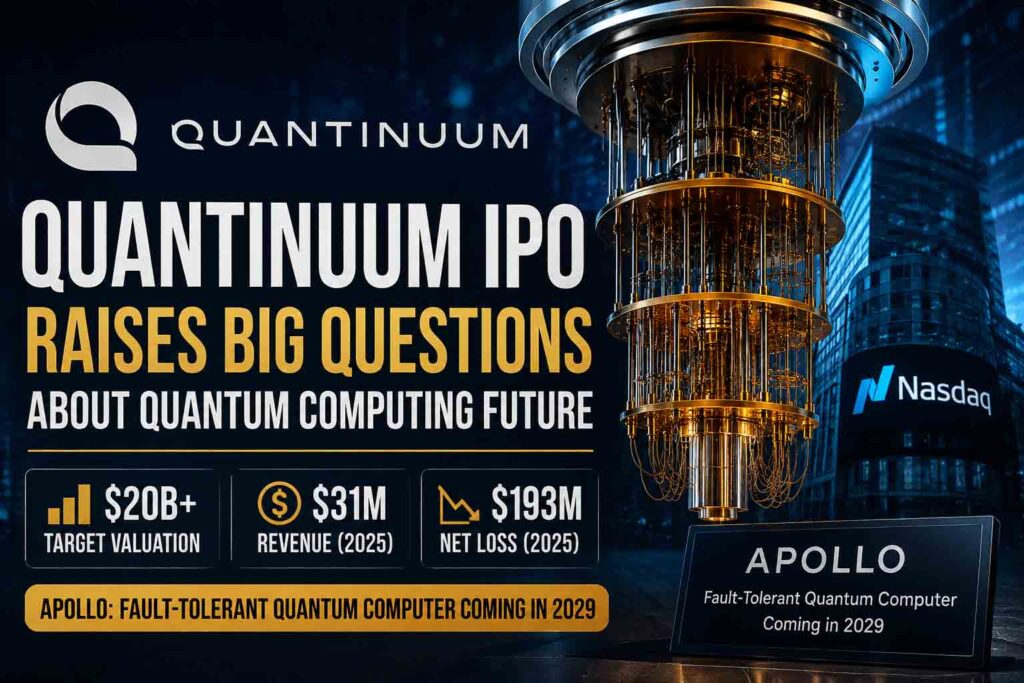
Quantum computing has spent decades existing somewhere between scientific breakthrough and commercial fantasy. Now, one company is asking Wall Street to put a $20 billion price tag on that future.
Honeywell-backed Quantinuum officially filed for a US initial public offering this week, aiming for a valuation that would instantly make it one of the most valuable pure-play quantum computing companies in the world. The move comes despite the company generating just $30.9 million in annual revenue while posting nearly $193 million in losses.
The filing is less about current business fundamentals and more about investor belief. Quantinuum is effectively asking public market investors to finance a future where quantum computers become commercially transformative — even though the company’s most ambitious machine does not yet exist.
Table of Contents
- What Is Quantinuum?
- Why the Quantinuum IPO Matters
- Quantinuum Financial Numbers Explained
- The Apollo Quantum Computer
- How Quantum Computing Works
- Major Customers and Investors
- The Quantum Computing Market
- Big Risks Investors Should Know
- Quantinuum vs IonQ and Other Competitors
- Future of Quantum Computing
- FAQ
What Is Quantinuum?
Quantinuum was created in 2021 after the merger of Honeywell Quantum Solutions and Cambridge Quantum Computing. The company focuses on developing advanced quantum computing systems using trapped-ion technology.
Unlike traditional computers that use binary bits, quantum computers use qubits. These qubits can process multiple states simultaneously, potentially allowing quantum systems to solve highly complex calculations much faster than classical machines.
The Company believes trapped-ion systems provide better accuracy and stability compared to competing architectures. According to the company, it achieved the highest average two-qubit gate fidelity in the industry as of late 2025.
The company plans to trade on the Nasdaq under the ticker symbol QNT.
Why the Quantinuum IPO Matters
The Quantinuum IPO is important because it represents one of the biggest public market tests for quantum computing enthusiasm.
For years, quantum computing has been described as a revolutionary technology that is “five to ten years away.” That timeline has barely changed despite billions of dollars flowing into research and development.
Now investors must decide whether the industry is finally approaching commercial reality or whether the excitement has once again moved ahead of practical adoption.
Unlike software startups that can scale quickly after product-market fit, quantum computing companies require enormous research spending, specialized hardware, and years of scientific progress before profitability becomes realistic.
That makes Quantinuum’s valuation especially aggressive.
Quantinuum Financial Numbers Explained
Quantinuum generated $30.9 million in revenue during 2025. That represented 34% growth compared to the previous year.
However, losses also expanded sharply. The company reported a net loss of $192.6 million for the year.
What stands out most is the valuation multiple. At a $20 billion valuation, investors would effectively be paying more than 600 times annual revenue.
In traditional technology investing, such multiples would appear extremely difficult to justify. But quantum computing is being valued less like a normal business and more like a long-term scientific platform.
The company’s first-quarter 2026 numbers also raised concerns.
- Revenue dropped from $19.1 million to $5.2 million
- Losses widened from $30.5 million to $136.6 million
- Revenue appears highly dependent on milestone-based contracts
These financial patterns are common among deep-tech startups where commercialization remains limited.
The Apollo Quantum Computer
The real centerpiece of Quantinuum’s story is Apollo.
Apollo is the company’s planned universal fault-tolerant quantum computer expected around 2029. The machine does not yet exist in its final form, but it represents the core reason investors are assigning such a massive valuation.
A fault-tolerant quantum computer would theoretically solve one of the industry’s biggest problems: error correction.
Current quantum systems are highly sensitive and prone to computational noise. Even tiny environmental disturbances can produce inaccurate outputs.
Apollo aims to overcome those limitations through advanced error correction systems capable of delivering stable, reliable calculations.
If successful, such machines could transform industries including:
- Drug discovery
- Financial modeling
- Artificial intelligence
- Materials science
- Battery development
- Climate simulations
- Cryptography
How Quantum Computing Works
Quantum computers operate using principles of quantum mechanics rather than classical binary logic.
Traditional computers use bits represented as either 0 or 1. Quantum systems use qubits, which can exist in multiple states simultaneously through a phenomenon called superposition.
This allows quantum systems to evaluate many possibilities at the same time.
Quantinuum’s trapped-ion architecture uses individual charged atoms suspended by electromagnetic fields. Lasers manipulate these ions to perform calculations.
Theoretically, this architecture offers strong stability and precision advantages over competing methods like superconducting qubits.
However, scaling remains extraordinarily difficult.
Maintaining coherence across large numbers of qubits while reducing computational errors is one of the biggest engineering challenges in modern computing.
For more technical background on quantum computing, readers can explore resources from IBM Quantum and Google Quantum AI.
Major Customers and Investors
Quantinuum has attracted partnerships with several major corporations:
- BMW
- Airbus
- JPMorgan Chase
- HSBC
- Mitsui
- Thales
BMW recently expanded its partnership with Quantinuum to explore catalyst chemistry for fuel cells. Airbus is researching quantum simulations for hydrogen-powered aircraft.
JPMorgan has been working with Quantinuum since 2020 and remains one of the company’s most active software users.
Still, these relationships are primarily research collaborations rather than revenue-driving production deployments.
No major corporation currently relies on quantum computing in a way that meaningfully impacts its business operations.
The Quantum Computing Market
The global race for quantum leadership is accelerating.
Governments across Europe, the United States, and China are investing billions into quantum technologies.
France alone committed hundreds of millions of euros toward fault-tolerant quantum computing initiatives.
Industry analysts believe the long-term market opportunity could eventually reach hundreds of billions of dollars if quantum systems become commercially viable.
But timelines remain highly uncertain.
Even leading executives disagree on how quickly practical quantum computing will arrive.
- Google leadership estimates five to ten years
- NVIDIA leadership believes it may take fifteen years or more
- Industry experts continue debating commercialization timelines
Big Risks Investors Should Know
The biggest risk surrounding the Quantinuum IPO is that the company’s valuation depends heavily on future breakthroughs rather than present-day business performance.
Several major challenges remain:
- Quantum error correction is still unsolved at scale
- Commercial applications remain limited
- Revenue growth is inconsistent
- Operating losses are accelerating
- The technology timeline remains uncertain
There is also intense competition.
Large technology companies including Google, Microsoft, IBM, and Amazon continue investing heavily in quantum computing research.
Smaller competitors like IonQ, Rigetti Computing, and D-Wave are also racing toward commercial breakthroughs.
Quantinuum vs IonQ and Other Competitors
Quantinuum will enter a relatively small but highly speculative public quantum computing market.
IonQ remains one of the best-known pure-play quantum stocks. The company also uses trapped-ion technology and has generated stronger revenue growth compared to many peers.
Rigetti Computing focuses on superconducting qubits, while D-Wave specializes in quantum annealing systems.
Each company is pursuing different technological approaches, and it remains unclear which architecture will dominate in the long run.
The sector remains highly sentiment-driven, with stock prices often reacting more to research milestones and funding announcements than to traditional financial metrics.
Future of Quantum Computing
The future of quantum computing remains both exciting and uncertain.
If fault-tolerant systems like Apollo become commercially successful, the industry could reshape everything from medicine to national security.
However, the road ahead is filled with scientific, engineering, and financial obstacles.
Quantinuum’s IPO ultimately represents a massive wager on that future.
Investors are not buying the company for what it earns today. They are buying the possibility that quantum computing eventually becomes one of the most important technological shifts of the century.
Whether Apollo arrives on schedule — and whether it performs as promised — could determine whether Quantinuum becomes the next transformational technology company or another example of hype outrunning reality.
FAQ
What is Quantinuum?
Quantinuum is a quantum computing company formed through the merger of Honeywell Quantum Solutions and Cambridge Quantum Computing.
What is the Quantinuum IPO valuation?
The company is targeting a valuation above $20 billion in its US IPO filing.
What is Apollo quantum computer?
Apollo is Quantinuum’s planned fault-tolerant quantum computer expected around 2029.
Is quantum computing commercially useful today?
Not at large commercial scale. Most current deployments remain experimental or research-focused.
Who owns Quantinuum?
Honeywell owns approximately 54% of Quantinuum.
What ticker will Quantinuum use?
The company plans to trade under the ticker symbol QNT on Nasdaq.
Internal Link Suggestion: Best AI and Quantum Computing Stocks to Watch
External Sources: