
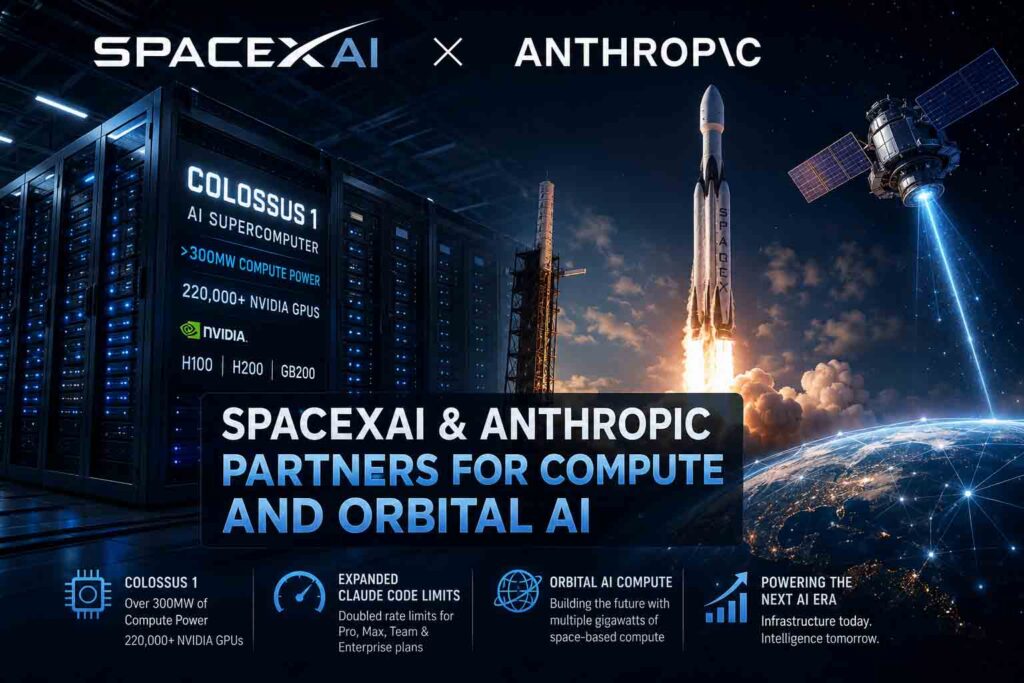
SpaceXAI and Anthropic partnership is becoming one of the biggest developments in the artificial intelligence industry in 2026. Anthropic has officially gained access to the massive Colossus 1 AI supercomputer infrastructure operated by SpaceXAI. The collaboration is expected to significantly improve Claude AI performance, increase compute availability, and open the door for future orbital AI compute systems.
The agreement comes at a time when AI companies are facing severe shortages in compute capacity. As AI adoption rapidly increases worldwide, companies need more GPUs, more electricity, and larger infrastructure to train next-generation AI models. SpaceXAI’s Colossus 1 system now provides Anthropic with access to over 300 megawatts of compute power using more than 220,000 NVIDIA GPUs.
What is Colossus 1 AI Supercomputer?
Colossus 1 is one of the world’s largest AI supercomputers built specifically for machine learning workloads, AI training, multimodal systems, scientific simulations, and large-scale inference operations. The infrastructure is operated by SpaceXAI and includes high-end NVIDIA hardware such as H100, H200, and next-generation GB200 accelerators.
The system was developed at record speed and is now considered among the most advanced AI compute clusters globally. According to industry experts, the availability of such infrastructure can directly determine how quickly AI companies can build and deploy next-generation artificial intelligence systems.
Large language models like Claude AI require enormous computational resources. Training these systems involves processing massive datasets using tens of thousands of GPUs simultaneously. Colossus 1 gives Anthropic a substantial advantage in scaling future AI models.
300MW Compute Power Explained
The SpaceXAI and Anthropic partnership gives Anthropic access to more than 300 megawatts of compute power. This scale of compute infrastructure is extremely rare and represents one of the largest AI-focused deployments in the world.
The system includes over 220,000 NVIDIA GPUs operating together in high-performance clusters. These GPUs are capable of handling advanced AI workloads including:
- Frontier-scale AI training
- Multimodal AI systems
- Scientific simulations
- Enterprise AI inference
- Generative AI applications
- Large-scale coding models
AI companies globally are competing for access to compute resources because GPU demand continues to exceed supply. Infrastructure availability is now becoming the biggest competitive factor in the AI race.
For more technology infrastructure developments, also read: Apple’s Record Earnings Explained: What Tim Cook’s Exit Means for iPhone, AI & Investors in 2026.
Elon Musk’s Statement on Anthropic
Elon Musk, Chief Executive Officer of SpaceXAI, publicly discussed the partnership after spending time with Anthropic’s leadership team. Interestingly, Musk previously criticized Anthropic in the past, even describing the company negatively during earlier AI debates.
However, Musk’s tone changed after direct discussions with the company’s executives. According to his statement on X, he was impressed by the competence and ethical focus of the Anthropic team.
“Everyone I met was highly competent and cared a great deal about doing the right thing.”
Musk explained that SpaceXAI had already shifted some of its internal training systems toward Colossus 2 infrastructure, making it possible to lease Colossus 1 capacity to Anthropic.
This development highlights how AI competitors are increasingly becoming infrastructure partners due to the massive cost and complexity involved in building next-generation compute systems.
Claude Code Rate Limits Doubled
Following the new compute agreement, Anthropic announced major upgrades for Claude Code and Claude API users. The company doubled five-hour rate limits for Pro, Max, Team, and Enterprise plans.
Peak-hour restrictions that previously affected users during heavy traffic periods have also been reduced. Anthropic confirmed that Claude Opus models will now operate with higher usage limits and improved stability.
The increase in available compute power directly benefits developers, businesses, and enterprise users relying on Claude AI for coding assistance, automation, document analysis, and AI workflows.
Anthropic also stated that additional compute agreements with companies including Amazon, Google, Broadcom, Microsoft, and NVIDIA contributed to expanded infrastructure capacity.
Visit Anthropic’s official website to learn more about Claude AI systems.
Orbital AI Compute Partnership
One of the most fascinating aspects of the SpaceXAI and Anthropic partnership is the long-term plan for orbital AI compute infrastructure.
Anthropic expressed interest in collaborating with SpaceXAI to develop multiple gigawatts of AI compute capacity in orbit. If successful, this could completely transform the future of artificial intelligence infrastructure.
Traditional AI data centers face increasing limitations related to:
- Electricity consumption
- Cooling requirements
- Land availability
- Environmental impact
- Power grid constraints
Space-based compute systems could potentially solve many of these challenges by utilizing near-limitless solar energy in orbit. SpaceXAI’s launch capabilities and satellite operations experience make the concept more realistic than ever before.
Industry analysts believe orbital AI compute may eventually become necessary as AI models continue growing exponentially in size and energy requirements.
Future of AI Infrastructure
The AI industry is rapidly entering an infrastructure race where compute power determines innovation speed. Companies with access to larger GPU clusters can train more capable models faster and deploy advanced AI products sooner.
According to Anthropic CEO Dario Amodei, demand for AI services has grown dramatically. The company reportedly experienced massive annualized growth in both revenue and platform usage.
As more businesses integrate AI into daily operations, infrastructure demand is expected to rise even further. This includes sectors such as:
- Software development
- Healthcare AI
- Scientific research
- Financial analysis
- Autonomous systems
- Enterprise automation
Companies unable to secure sufficient compute infrastructure may struggle to compete effectively in the coming years.
Impact on AI Industry in 2026
The SpaceXAI and Anthropic partnership could reshape the global AI industry by demonstrating how infrastructure partnerships are becoming essential for scaling advanced AI systems.
Rather than competing solely through algorithms, AI companies are now competing through energy access, GPU procurement, data center construction, and infrastructure deployment speed.
The partnership also highlights the growing importance of NVIDIA GPUs in powering modern AI systems. NVIDIA hardware remains the backbone of nearly every major AI company worldwide.
Experts believe the next phase of AI competition will focus on sustainable compute expansion, energy efficiency, and orbital infrastructure possibilities.
If orbital AI compute becomes commercially viable, it could represent one of the biggest technological transformations since the rise of cloud computing itself.
Conclusion
The collaboration between SpaceXAI and Anthropic marks a major milestone in the future of artificial intelligence infrastructure. With access to Colossus 1, Anthropic gains enormous compute capacity that can accelerate Claude AI development, improve enterprise performance, and support next-generation AI research.
At the same time, the discussion around orbital AI compute introduces a futuristic vision where space-based infrastructure may power the next era of artificial intelligence. As demand for AI continues exploding worldwide, partnerships like this could define which companies lead the industry over the next decade.
Frequently Asked Questions (FAQs)
1. What is the SpaceXAI and Anthropic partnership?
The SpaceXAI and Anthropic partnership is a major AI infrastructure collaboration where Anthropic gains access to the Colossus 1 AI supercomputer for advanced AI training, inference, and compute expansion.
2. What is Colossus 1 AI supercomputer?
Colossus 1 is one of the world’s largest AI supercomputers operated by SpaceXAI. It uses more than 220,000 NVIDIA GPUs and delivers over 300MW of compute power for machine learning workloads.
3. Why does Anthropic need more compute power?
Anthropic requires massive compute infrastructure to train and operate advanced Claude AI models. Growing demand from developers and enterprise users has significantly increased infrastructure requirements.
4. How will Claude Code users benefit from this deal?
Following the partnership, Anthropic doubled Claude Code usage limits for Pro, Max, Team, and Enterprise users. Peak-hour restrictions were also reduced.
5. What is orbital AI compute?
Orbital AI compute refers to AI computing infrastructure placed in space. The idea is to use space-based energy and satellite infrastructure to support future AI systems with nearly limitless sustainable power.
6. Why is orbital AI compute important?
AI data centers consume enormous electricity and cooling resources. Orbital AI compute could reduce pressure on Earth’s infrastructure while enabling larger and more powerful AI systems.
7. What GPUs are used in Colossus 1?
Colossus 1 includes NVIDIA H100, H200, and next-generation GB200 accelerators designed for large-scale AI training and inference tasks.
8. Did Elon Musk support the Anthropic deal?
Yes. Elon Musk stated that after meeting Anthropic’s leadership team, he was impressed by their competence and commitment toward responsible AI development.
9. Which companies are helping Anthropic expand compute capacity?
Anthropic has infrastructure agreements with Amazon, Google, Broadcom, Microsoft, NVIDIA, and now SpaceXAI to expand AI compute resources.
10. How does this partnership impact the AI industry?
The partnership highlights how compute infrastructure is becoming the most important competitive advantage in artificial intelligence development during 2026 and beyond.