
AI Replacing Jobs in USA: The conversation about Artificial Intelligence (AI) taking over the world has shifted from science fiction movies to corporate boardrooms in the United States. As we move through 2026, the “AI Revolution” is no longer a prediction—it is a lived reality for thousands of American workers. While we haven’t seen a total “job apocalypse” where machines do everything, we are witnessing a massive reorganization of how work happens.
For the first time, AI is being cited as a top reason for unemployment. Instead of just being a tool to help us work faster, some companies are now choosing software over people to save money. This change is hitting specific industries hard, while others remain surprisingly safe.
The Numbers Behind the 2026 Shift
Recent data from March 2026 shows a startling trend: over 15,000 job cuts in the U.S. were directly linked to AI adoption. This represents a staggering 25% of all job losses for that month. The technology sector, once the safest bet for a high-paying career, has been the epicenter of this disruption. In the first three months of 2026 alone, tech companies like Meta, Oracle, and Salesforce slashed over 52,000 positions.
Experts point out that these companies aren’t necessarily shrinking; they are “reallocating.” This means the money that used to pay human salaries is now being spent on expensive AI chips and data centers. Essentially, the budget for a team of ten programmers might now be spent on one senior developer using a highly advanced AI system.
White-Collar Workers in the Crosshairs
For decades, the “safe” path was to get a college degree and work in an office. However, 2026 is proving that AI is exceptionally good at “thinking” tasks. High-skilled roles that require data analysis, coding, or basic design are now the most vulnerable.
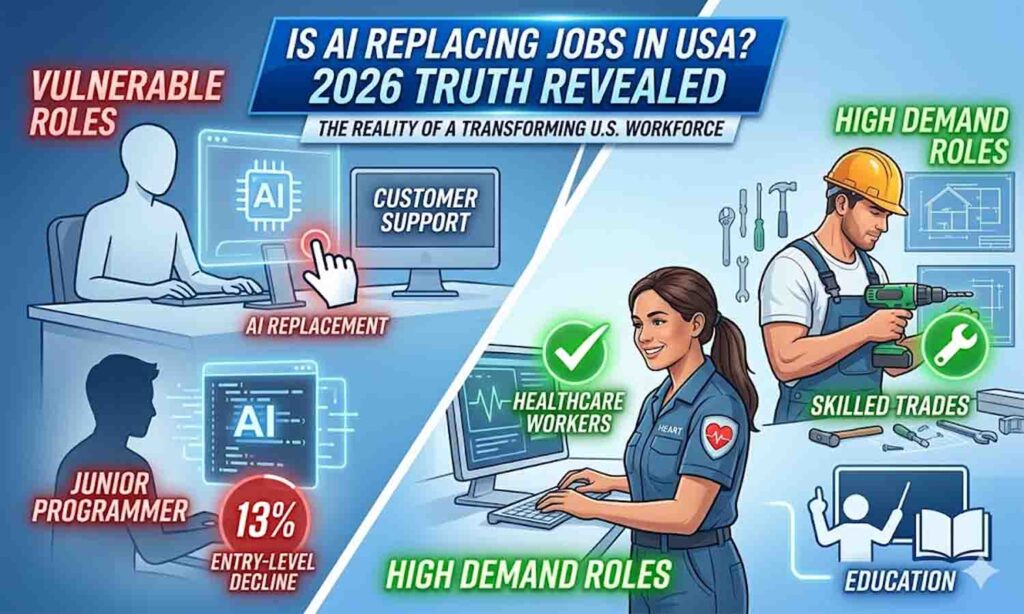
- Junior Programmers: Tools like GitHub Copilot have become so advanced that one senior developer can now do the work that used to require three junior assistants.
- Data Analysts: AI can sort through millions of spreadsheets in seconds, identifying trends that would take a human team weeks to find.
- Customer Service: The “chatbots” of 2026 are nearly indistinguishable from humans, leading many companies to shut down large call centers in favor of automated systems.
The “Hidden” Struggle for Young Workers
Perhaps the most concerning trend of 2026 is the impact on young people. Employment for workers under the age of 25 has dropped by 13% in fields heavily exposed to AI. This is happening because “entry-level” tasks—the simple jobs graduates do to learn the ropes—are the easiest for AI to handle. Without these “stepping stone” jobs, many young Americans are finding it harder to start their careers, leading to what some call a “hollowing out” of the middle class.
The Scapegoat Effect: Is AI Always to Blame?
Interestingly, not every “AI-related” layoff is actually about AI. Economic analysts have noticed a “Scapegoat Effect.” Some companies use “AI adoption” as a trendy excuse for routine cost-cutting. By blaming a “technological shift,” they avoid the negative PR of simply saying they wanted to increase profits. In many cases, these companies haven’t even fully installed an AI system yet; they are simply betting that they can figure it out later with fewer people on the payroll.
Safe Havens: Where Humans Still Win
While the news seems grim for office workers, many jobs are thriving. AI still struggles with three major things: physical touch, deep empathy, and complex physical environments.
- Skilled Trades: You cannot download a robot to fix a burst pipe in an old basement or wire a new home. Plumbers, electricians, and HVAC technicians are in higher demand than ever.
- Healthcare: While AI can help diagnose a disease, it cannot provide the comfort of a nurse or the nuanced therapy of a psychologist.
- Education: Even with the best AI tutors, the “human touch” in teaching—mentoring, discipline, and emotional support—has proven irreplaceable for students.
Transformation Over Replacement
The World Economic Forum recently updated its outlook, suggesting that while AI will displace nearly 92 million jobs globally by 2030, it will also create 170 million new ones. The catch? These new jobs require entirely different skills.
In 2026, the slogan “AI won’t take your job, but a person using AI will” has become the golden rule. The “Full Truth” is that we are in a transition period. The workers who are surviving and thriving are those who have learned to treat AI as a powerful assistant rather than a competitor. For the American workforce, the challenge isn’t just about losing jobs—it’s about the urgent need to learn new ways to work in a world where the machines are finally catching up.